 Admin
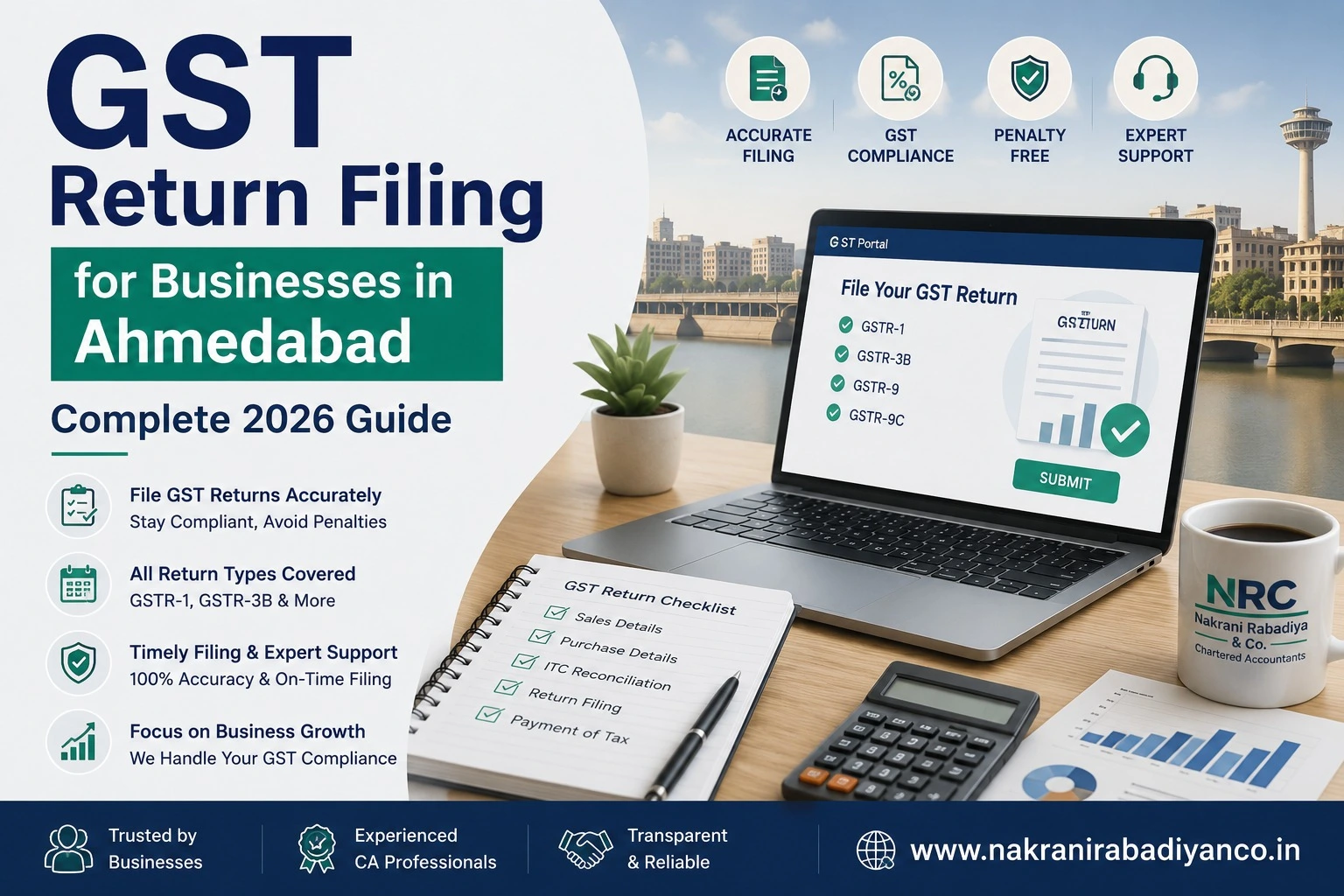
AdminGST Return Filing for Businesses in Ahmedabad - Complete 2026 Guide
If you run a business in Ahmedabad – whether it’s a small shop in Narol, a software firm on SG Highway, or a trading company in Navrangpura – there is one thing you cannot ignore every single month: filing your GST returns.
Missing a deadline or filing with errors can mean penalties, blocked credits, and sometimes even a frozen GSTIN – which stops your business from issuing invoices altogether.
The good news? GST return filing is not complicated once you understand the basics.
1. What is GST Return Filing – and Why Should You Care?
When your business is registered under GST, the government expects you to regularly report two things:
- How much you sold (your sales / outward supplies)
- How much you bought or spent on which GST was already paid (your purchases / inward supplies)
Based on these two numbers, the government calculates how much GST you owe – or whether you are eligible for a refund. Filing a GST return is simply the process of submitting this information on the GST portal (gstn.gov.in) on time.
Why does it matter if you skip or delay it?
- Late fees: ₹50 per day if there is tax payable, ₹20 per day if your return is nil (i.e., no sales that month) – capped at ₹5,000 per return.
- Interest: 18% per year on any unpaid tax – charged from the due date to the actual payment date.
- ITC blockage: If your supplier hasn’t filed their return, you might lose the credit on what you paid them – directly hurting your cash flow.
- GSTIN suspension: Consistent non-filing can lead to your GST registration being cancelled. Once suspended, you cannot issue a GST invoice – which means you cannot do business with GST-registered clients.
| Think of GST return filing like paying your electricity bill. You can ignore it for a month – but the penalties keep piling up, and eventually they cut the connection.
2. Which GST Returns Do Ahmedabad Businesses Need to File?
Most businesses in Ahmedabad file two returns every month (or every quarter if their turnover is lower). Here is a plain-English explanation of each:
GSTR-1 – Your Sales Report
GSTR-1 is where you list all the sales your business made during the month. Every invoice you raised – whether to another business or to a consumer – goes into this return.
- Who files it? Every GST-registered business.
- When? By the 11th of the following month if your annual turnover exceeds ₹5 crore. If your turnover is lower, you may file quarterly – by the 13th of the month after the quarter ends.
- Simple example: July 2026 sales are reported in GSTR-1 filed by 11th August 2026.
GSTR-3B – Your Monthly Summary & Tax Payment
GSTR-3B is a summary return where you declare your total sales, total purchases, and the net GST you owe after adjusting for what you already paid on your purchases (called Input Tax Credit or ITC).
This is also where you actually pay your GST for the month. Think of it as your monthly GST settlement with the government.
- Who files it? Every regular GST-registered taxpayer.
- When? By the 20th of the following month for businesses with turnover above ₹5 crore. For smaller businesses under the QRMP scheme, by the 22nd or 24th of the month after the quarter ends.
- Important: Gujarat falls in the 24th category for quarterly GSTR-3B filing under QRMP.
| What is QRMP? The Quarterly Return Monthly Payment scheme allows smaller businesses (annual turnover up to ₹5 crore) to file returns quarterly instead of monthly – but they still pay tax monthly. Less paperwork, same tax discipline.
GSTR-9 – Your Annual Return
At the end of the financial year, you file one comprehensive summary of everything you reported throughout the year. This is GSTR-9 – your annual GST return.
- Who files it? All registered businesses with annual turnover above ₹2 crore.
- When? By 31st December following the financial year. For FY 2025–26, the deadline is 31st December 2026.
- Turnover above ₹5 crore? You also need to file GSTR-9C – a reconciliation statement that must be certified by a Chartered Accountant.
Quick Reference: GST Return Deadlines for FY 2025–26
| Return Form | Who files it | Frequency | Due Date |
| GSTR-1 | All regular taxpayers | Monthly (or quarterly) | 11th of next month (monthly) / 13th after quarter end |
| GSTR-3B | All regular taxpayers | Monthly (or quarterly) | 20th of next month (monthly) / 22nd or 24th after quarter |
| GSTR-9 | Turnover above ₹2 crore | Annual | 31st December 2026 |
| GSTR-9C | Turnover above ₹5 crore | Annual | 31st December 2026 |
| CMP-08 | Composition scheme dealers | Quarterly | 18th of month after quarter end |
| GSTR-4 | Composition scheme dealers | Annual | 30th April after FY ends |
3. What is Input Tax Credit – and Why Getting It Right Matters
Input Tax Credit (ITC) is one of the biggest advantages of being GST-registered. Here’s the simple version:
When you buy goods or services for your business and pay GST on them, you can use that GST amount to reduce the tax you owe on your sales. You don’t pay it twice.
Example: You buy raw material worth ₹1,00,000 and pay ₹18,000 as GST. You then sell finished goods for ₹2,00,000 and collect ₹36,000 as GST. Instead of paying the full ₹36,000, you adjust the ₹18,000 you already paid – and pay only ₹18,000 to the government. That ₹18,000 saving is your ITC.
The catch? You can only claim ITC that appears in your auto-generated GSTR-2B statement. This means your supplier must have filed their GSTR-1 on time and correctly. If they haven’t, your credit disappears – and you end up paying more tax than you should.
| This is the biggest practical reason why working with a CA for GST filing makes sense – they reconcile your GSTR-2B every month and chase up suppliers whose delayed filings are costing you money.
From April 2026, the GST portal has introduced tighter controls on ITC. A system called ECRS now monitors all ITC claims and reversals automatically. If your books show a negative ITC balance, the portal will block your GSTR-3B filing until it is resolved. Keeping your monthly records clean is no longer optional – it’s a technical requirement.
4. Common GST Filing Mistakes Ahmedabad Businesses Make
These are the errors our CA team sees most often – especially among growing businesses that try to manage GST filing in-house without enough time or expertise:
Mistake 1 – Filing GSTR-1 but forgetting GSTR-3B
Both returns are mandatory every month. Many business owners assume filing one is enough. It is not. The penalty clock runs on both independently.
Mistake 2 – Mismatch between GSTR-1 and GSTR-3B
Your GSTR-1 (sales list) and GSTR-3B (summary) must match. If you show ₹10 lakh in sales on GSTR-1 but ₹8 lakh on GSTR-3B, the GST department’s system flags it automatically. This can trigger a notice.
Mistake 3 – Claiming ITC not in GSTR-2B
As mentioned above – you can only claim what is in your auto-populated GSTR-2B. Claiming credits that are not there is one of the most common reasons GST notices are issued in Ahmedabad.
Mistake 4 – Wrong HSN codes on invoices
Every product and service has an HSN (Harmonised System of Nomenclature) code – think of it as a category code for GST. Using the wrong code means you may be charging the wrong tax rate, which causes problems during annual filing and audits.
Mistake 5 – Ignoring the annual return (GSTR-9)
Many businesses focus only on monthly returns and forget the annual return entirely. GSTR-9 is where the entire year is reconciled. Errors in monthly returns often surface here – and the late fee for GSTR-9 is ₹200 per day (₹100 CGST + ₹100 SGST), capped at 0.25% of your annual turnover.
Mistake 6 – Not starting a fresh invoice series on April 1st
Every new financial year, you must start a new invoice numbering series. Continuing from the previous year creates reconciliation errors. For example, if your last March 2026 invoice was INV-5000, your first April 2026 invoice must be on a fresh series – not INV-5001.
| Received a GST notice in Ahmedabad? Don’t ignore it. Most GST notices have a 15–30 day response window. Missing the response deadline makes the situation significantly worse. A CA can draft a proper response and represent you before the GST department.
Read More: How to Choose the Right CA Firm for Your Business
5. GST Filing for Different Types of Ahmedabad Businesses
Not every business files the same returns. Here is a quick guide based on your business type:
Traders and Retailers (Narol, Odhav, Old City)
If you are a trader – buying and reselling goods – you file GSTR-1 and GSTR-3B monthly or quarterly depending on your turnover. ITC on your purchases is your biggest advantage. Ensure your suppliers are filing on time so your credits are not lost.
IT and Service Businesses (SG Highway, Prahlad Nagar)
Service businesses also file GSTR-1 and GSTR-3B. One important thing for service businesses: if your annual turnover is above ₹20 lakh (₹10 lakh for some special category states), GST registration is mandatory. Many IT freelancers and consultants cross this limit without realising it.
Manufacturers (Changodar, Bavla, Vatva)
Manufacturers have additional compliance – particularly around e-way bills for goods movement, and job work GST implications if they send goods to another unit for processing. HSN code accuracy is especially critical for manufacturers.
Real Estate Developers and Agents (Bopal, Thaltej, Prahlad Nagar)
Real estate GST is complex. Builders must file monthly GST returns on under-construction project collections. Brokerage/commission income is also taxable. Capital goods ITC rules apply differently here.
Small Businesses Under the Composition Scheme
If your annual turnover is below ₹1.5 crore (₹75 lakh for service businesses), you can opt for the Composition Scheme – a simplified tax structure where you pay a fixed percentage of turnover instead of full GST. Composition dealers file CMP-08 quarterly and GSTR-4 annually, with far less paperwork.
| Are you eligible for the Composition Scheme? Check with a CA – it could significantly reduce your compliance burden and monthly costs. However, note that composition dealers cannot issue GST invoices to other businesses, which limits your B2B client base.
6. Should You File GST Returns Yourself or Hire a CA?
This depends on your business size and how much time you can realistically dedicate to compliance.
Filing yourself works fine if:
- Your business has very few transactions each month
- You are comfortable using the GST portal and accounting software like Tally or Zoho Books
- You have no ITC to claim (e.g., you only sell to consumers)
- Your turnover is below ₹5 crore and you are under the QRMP scheme
Hiring a CA makes more sense if:
- You have 50+ invoices per month – manual entry becomes error-prone quickly
- You deal with both B2B (businesses) and B2C (consumers) transactions
- You are a manufacturer or trader with complex ITC claims
- You have received a GST notice or are under scrutiny
- Your turnover is above ₹5 crore and GSTR-9C is mandatory
- You simply do not have the time – and one penalty wipes out months of money saved on fees
The practical reality for most Ahmedabad business owners: a CA handles your monthly GST filing for a fixed monthly fee – typically ₹1,500 to ₹5,000 depending on transaction volume – which is far less than a single month’s late filing penalty plus the lost ITC from an unchecked GSTR-2B mismatch.
7. New GST Rules in 2026 That Ahmedabad Businesses Must Know
GST law evolves every year. Here are the key changes in 2026 that are directly relevant to most Ahmedabad businesses:
Fresh Invoice Numbering Every April 1st
Starting each financial year, your invoice series must restart fresh. Continuing last year’s numbering creates reconciliation problems and can attract GST department scrutiny during audits.
ECRS – Stricter ITC Monitoring
From April 1, 2026, the GST portal uses an Electronic Credit Reversal and Reclaim Statement (ECRS) system. If your ITC ledger shows a negative balance, the system blocks GSTR-3B filing until you resolve it. Monthly reconciliation of your purchase records is now technically enforced – not just recommended.
E-Invoicing Expansion
E-invoicing (uploading invoices directly to the GST portal at the time of billing) has been expanded to more businesses. If your annual turnover exceeds ₹5 crore, e-invoicing is mandatory. Invoices not uploaded to the system may not be eligible for ITC by your buyers.
GST 2.0 – The Future of GST Compliance
The government is working on a next-generation GST system aimed at simplifying compliance through better automation, AI-based mismatched detection, and fully digital billing integration. While this is still rolling out, businesses should ensure their accounting software is GST-compliant and regularly updated.
Need Help with GST Return Filing in Ahmedabad? Talk to Our CA Team
Managing GST compliance alongside running your business is genuinely hard – especially when the rules change every few months and the portal has its own quirks.
At Nakrani Rabadiya & Co., our team of Chartered Accountants in Ahmedabad handles end-to-end GST compliance for businesses across Bopal, SG Highway, Navrangpura, Narol, Satellite, and the wider Ahmedabad region. From monthly GSTR-1 and GSTR-3B filing to annual GSTR-9 and GST notice resolution – we handle it all so you can focus on your business.
What we offer:
- Monthly GSTR-1 and GSTR-3B filing with GSTR-2B reconciliation
- Annual GSTR-9 and GSTR-9C (for eligible businesses)
- GST registration and amendment services
- GST notice drafting and representation
- ITC optimisation and mismatch resolution
- Fixed, transparent pricing – no surprise bills