 Admin
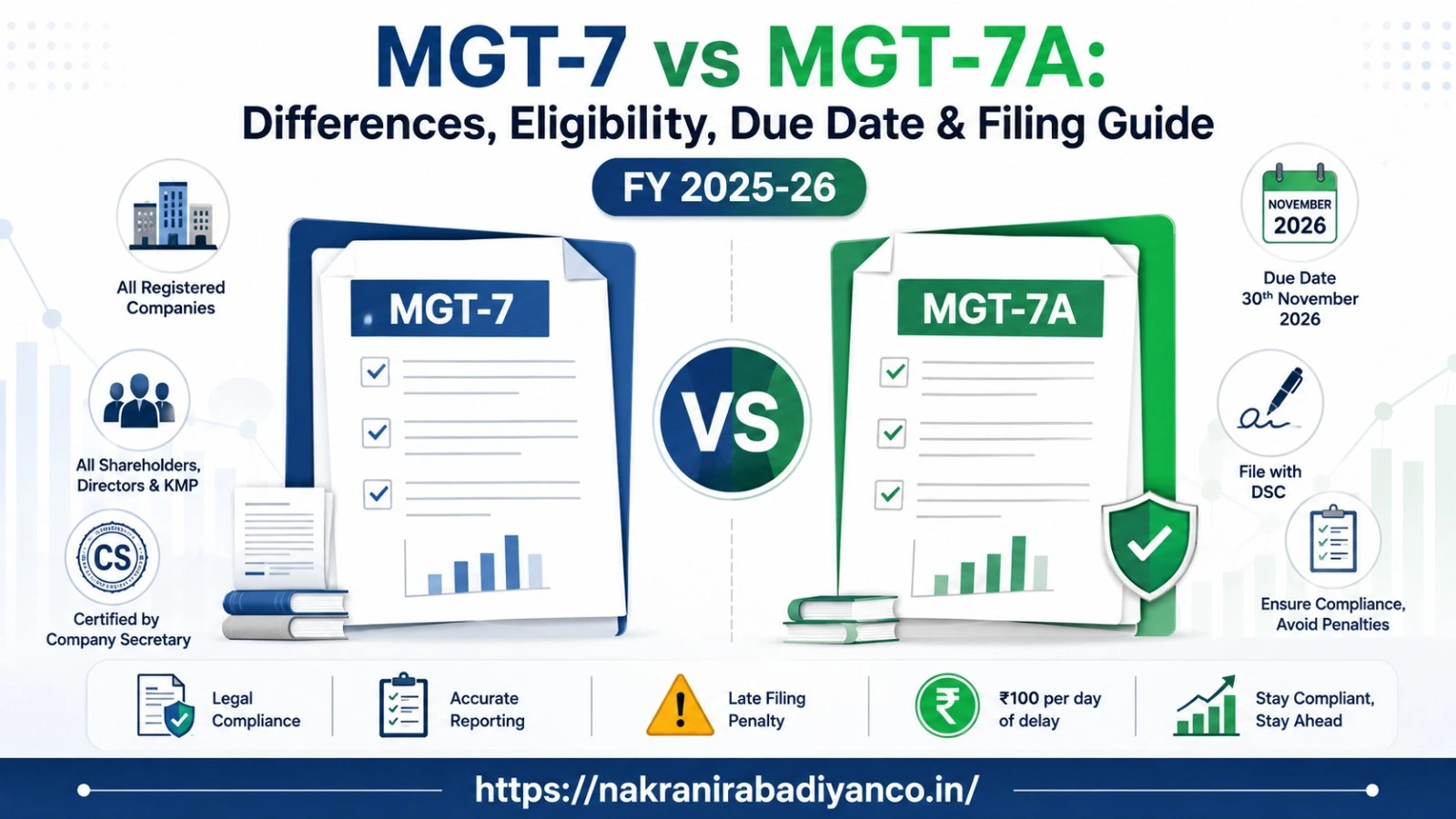
AdminMGT-7 vs MGT-7A: Key Differences, Eligibility, Due Date & Filing Process (FY 2025-26)
Every registered company in India — private, public, OPC, or small company — must file an annual return with the Ministry of Corporate Affairs (MCA) every year. This is separate from your income tax return; it tells the Registrar of Companies (ROC) who your shareholders are, who your directors are, and how your company is structured.
Depending on eligibility, you will file one of two forms: MGT-7 or MGT-7A. Filing the wrong one, or filing late, invites daily penalties. Here’s a plain-language breakdown of both forms, who needs which one, the due dates for FY 2025-26, and where businesses commonly go wrong.
What is Form MGT-7? Eligibility, Purpose & Who Should File
Form MGT-7 is the standard annual return required under Section 92 of the Companies Act, 2013. It applies to all companies other than One Person Companies (OPCs) and small companies eligible to file the abridged MGT-7A. The form captures detailed information: registered office address, principal business activities, shareholding pattern, details of promoters, directors and key managerial personnel (KMP), board meeting records, director remuneration, and any changes in management during the year.
Whether MGT-7 additionally needs certification from a Practising Company Secretary (PCS) in Form MGT-8 is governed separately by Rule 11(2) of the Companies (Management and Administration) Rules, 2014, covered below.
What is Form MGT-7A? Eligibility, Purpose & Benefits
Form MGT-7A is a shorter version of the annual return, introduced by the MCA in 2021 to reduce the paperwork burden on smaller entities. It applies only to OPCs and companies that qualify as “small companies” under Section 2(85).
It skips disclosures that don’t apply to simple ownership structures, such as detailed board composition and KMP information. If your company genuinely meets the small company criteria, MGT-7A is faster and cheaper to file — but filing it when you don’t actually qualify counts as a compliance lapse, not a shortcut.
Who Should File MGT-7 vs MGT-7A: Eligibility Explained
The deciding factor is whether your company qualifies as a “small company” under Section 2(85) of the Companies Act. Until recently, that meant a private company (other than a public, holding, subsidiary, or Section 8 company) with paid-up share capital up to ₹4 crore and turnover up to ₹40 crore, both conditions required together.
The MCA revised this definition vide Notification No. G.S.R. 880(E) dated December 1, 2025, raising the thresholds to ₹10 crore paid-up capital and ₹100 crore turnover, effective from FY 2025-26 onward. Even within these limits, a company still cannot qualify as small if it is a public company, a holding or subsidiary company, a Section 8 (non-profit) company, or a company governed by a special Act.
- As a general rule for FY 2025-26:
- One Person Companies (OPCs) — always file MGT-7A
- Private companies meeting the revised small company thresholds, and not falling under any exclusion — file MGT-7A
- All other private companies — file MGT-7
- All public companies, regardless of size — file MGT-7
- Holding companies, subsidiary companies, and Section 8 companies — file MGT-7, even if their capital or turnover is within small company limits
Since this is a recent notification, confirm your company’s classification with your CA or CS before filing if your figures are close to the revised limits.
MGT-7 & MGT-7A Due Date for FY 2025-26 (AY 2026-27)
Both forms follow the same timeline. Under Section 92(4) of the Companies Act, the annual return must be filed within 60 days from the date the Annual General Meeting (AGM) is held, or within 60 days from the date it should have been held, if the company delays or skips its AGM.
As a general rule, the AGM should be held within six months from the close of the financial year, subject to the provisions of the Companies Act. For most companies with a March 31 year-end, this means the AGM is due on or before September 30. If the AGM is held on September 30, 2026, the annual return — MGT-7 or MGT-7A — becomes due by November 29, 2026. OPCs are exempt from holding an AGM; their 60-day window instead runs from six months after the financial year-end, landing on the same November 29, 2026 date for a standard April–March year.
Missing this date does not remove the filing requirement — it simply adds an additional fee from the first day of delay.
Documents and Information Required for MGT-7/MGT-7A Filing
Corporate Identity Number (CIN) and PAN of the company
- Registered office address and details of any change during the year
- Latest audited financial statements
- Share capital details, including any changes during the year
- List of shareholders with shareholding percentage as of the financial year-end
- Details of directors and KMP (for MGT-7)
- Details of any share transfers during the year
- Board meeting and AGM dates held during the year
- Details of holding, subsidiary, and associate companies, if any
- Debenture details, if applicable
- Digital Signature Certificate (DSC) of the signing director
- Practising Company Secretary’s DSC and membership details, where MGT-8 certification applies
Penalty for Late or Non-Filing of MGT-7 and MGT-7A
Delayed filing attracts an additional government fee of ₹100 per day, with no upper cap — a two-month delay alone can run into several thousand rupees. Beyond the daily fee, Section 92(5) provides for statutory penalties on the company and every officer in default, which can escalate for continued non-compliance.
Separately, under Section 164(2), a director can be disqualified from being appointed or reappointed to any company if annual returns or financial statements remain unfiled for three consecutive financial years — so persistent non-filing carries consequences well beyond the daily late fee.
Common Mistakes to Avoid When Filing MGT-7 or MGT-7A
- Filing MGT-7A when the company is a holding, subsidiary, Section 8, or public company that cannot qualify as small, regardless of its capital or turnover
- Missing the AGM date and miscalculating the 60-day filing window that follows
- Leaving out MGT-8 certification where the company crosses the ₹10 crore paid-up capital or ₹50 crore turnover threshold under Rule 11(2)
- Filing based on last year’s shareholding pattern instead of the position as of this year’s year-end
- Treating this as the same filing as AOC-4 — the two are separate forms with separate purposes and, in some cases, separate due dates
Need Help with MGT-7 or MGT-7A Filing? Contact Nakrani Rabadiya & Co.
Choosing the correct form and getting MGT-8 certification right the first time is where most companies lose money — not in the filing fee, but in the penalties and rework that follow a mistake. Nakrani Rabadiya & Co. is a Chartered Accountancy firm in Surat offering CA services in Ahmedabad, Navsari, Bharuch, Ankleshwar, Vapi, Valsad, Bhavnagar, Rajkot, and across Gujarat. Our Company Law & ROC Compliance team handles MGT-7 filing, MGT-7A filing, AOC-4 filing, ROC annual return filing, and full company secretarial compliance for private limited companies, OPCs, and small companies across Gujarat.
If your AGM is coming up or you are unsure which form applies to your company this year, reach out to us at +91 87339 59198. We will review your paid-up capital and turnover, confirm the right form, and handle the filing end-to-end so you never have to think about the deadline again.